
Riprap on Lake Martin: Alabama Power Rules, Permits, Timing & Cost
Riprap on Lake Martin is the shoreline fix Alabama Power says it prefers, but that doesn't make it a weekend project. Rock placed at the water's edge sits in Alabama Power's project lands and in waters the Army Corps of Engineers regulates, so a permit, a fee and a Corps verification come first. This guide covers who controls your shoreline, why riprap is favored, what new riprap and topping up old riprap each cost in fees, the Corps limits, what the rules leave for you and your contractor to settle, how the winter drawdown fits in, and what a job like this runs.
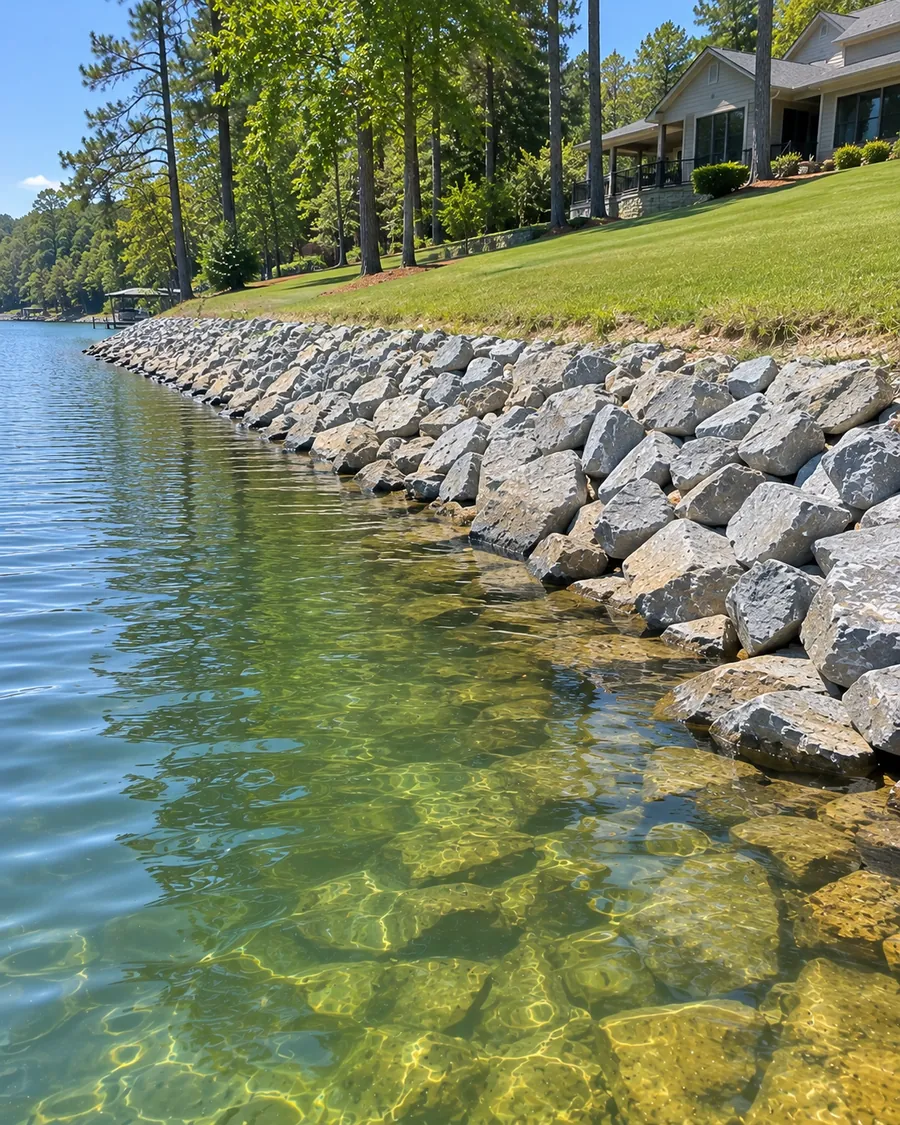
What riprap is, and what it looks like here
Riprap is loose, heavy rock laid over a bank so that waves and boat wakes spend their energy on stone instead of bare soil. It isn't mortared or stacked into a wall. It works because the pieces are heavy enough to stay put, they lock against each other, and water can drain through the gaps without carrying the bank away underneath.
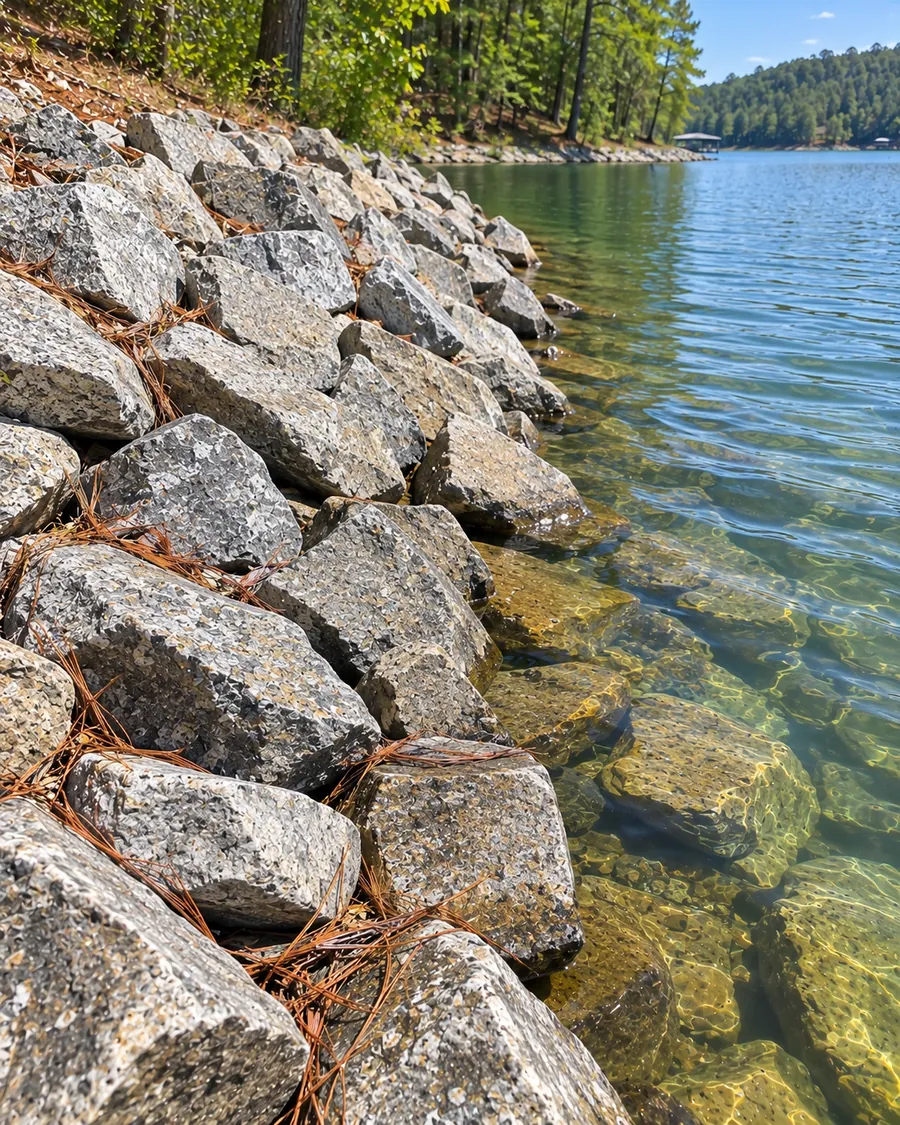
On Lake Martin, people often lump riprap in with seawalls. A 2021 column in Lake Martin Voice by local realtor John Coley put it this way: "In our area riprap (rip-rap, rip rap) is usually a volleyball or basketball sized granite rock," and "Riprap is usually the cheapest and quickest seawall to build at the lake." He's a realtor rather than an engineer, and the column has no prices, but it's a fair picture of what you'll see along the shore. If you're weighing a vertical wall instead, read seawalls on Lake Martin alongside this page.
Who controls the shoreline in front of your house
Lake Martin is a hydroelectric reservoir that Alabama Power operates under a Federal Energy Regulatory Commission license, FERC Project No. 349. Alabama Power's residential shoreline guidelines for Martin, Yates and Thurlow, revised July 11, 2025, use the 491-foot mean sea level contour as the project line at Martin (490 feet on the older Martin datum). On some lots, Alabama Power also holds a control strip: "At Lake Martin, Alabama Power possesses a control strip measuring 30' (horizontal) from the 491' MSL."
Not every lot has that strip. In a 2023 update, Alabama Power said it issued 4,167 Lake Martin permits between July 2017 and the end of 2022. About 67 percent were on unclassified shoreline, where it has "no authority through its SMP on property above full pool," and about 32 percent were on property where it maintains the 30-foot control strip. Riprap, though, goes at the waterline and below it, in the lakebed. Alabama Power's permits page says all work other than painting and pressure washing "in the lakebed, in the APC flood easement, or within the APC Control Strip" could require a permit. Whichever kind of lot you have, assume the rock needs one.
Why Alabama Power favors riprap
The bank stabilization section of the guidelines opens with a clear ranking: "Rip-rap and natural bank stabilization are the preferred methods of erosion control; however, potential use of seawalls will be evaluated on a case-by-case basis."
That puts riprap in a stronger position here than on some other lakes, where stone is a last resort. You still need a permit, but you aren't asking Alabama Power for something it discourages. The same paragraph sets rules that apply to any fill behind or under a stabilization job:
- "The source and kind of backfill must be approved by Alabama Power in its sole discretion."
- "Backfill may be placed only to the contour of the natural slope of the property."
- "No debris or foreign materials may be used as backfill."
- "No new creosote products may be used."
Elsewhere the guidelines bar "garbage or foreign materials (e.g., remnants of building material, old appliances, tires, etc.)" from project lands and waters. Broken concrete and leftover block from a renovation don't belong in a riprap bank on this lake.
New riprap versus topping up old riprap
The fee schedule in Section A-4 of the guidelines draws the line, and it's stricter than many owners expect.
Which riprap fee applies
- New riprap
- General Construction Fee, $400. It names "rip rap (or adding linear footage to existing rip rap)."
- Extending old riprap
- Also $400. Added length counts as new construction.
- More rock, same footprint
- General Repair Fee, $200, for repair "of a substantial degree (including but not limited to adding rip rap to an existing rip rap footprint)."
- Changing a permit
- Permit Modification Fee, $100.
- Work done first
- Unauthorized Construction Fee, $600; Unauthorized Structure Repair Fee, $400; Non-Compliance Fee, $800.
Whether a repair reaches "a substantial degree" is up to Alabama Power, and the guidelines ask owners to contact the local Shoreline Management office before any potentially substantial repair. They also say the General Construction Fee is paid at or before the permit is issued and the repair fee before the repair work. So the practical rule on Lake Martin is simple: if a truckload of rock is about to go on an old riprap bank, call Alabama Power first. A contractor calling it "maintenance" doesn't change how the guidelines treat it.
The Corps of Engineers side: APCO-PGP-05
Alabama Power isn't the only agency with a say over rock in the water. Federal authority runs through the U.S. Army Corps of Engineers, whose Mobile District covers minor shoreline work on Alabama Power's reservoirs with a set of programmatic general permits. The one that covers riprap is titled "APCO-PGP-05 Riprap for Shoreline, Bank, and Channel Protection; Bulkheads and Other Standard Shoreline Protection/Stabilization Devices Roughly Paralleling, and at the Shoreline or Bank."
For a homeowner, the request starts with Alabama Power. The PGP document says "A project specific verification must be obtained for all activities covered under the Alabama Power Company Programmatic General Permits (APCO-PGP) prior to the start of regulated activities," and that "Permit requests should be initiated via the APCO website at www.apcshorelines.com." The conditions that matter most for riprap:
- Bedding fill is capped, rock above the waterline isn't. "The bedding fill below the ordinary high-water mark may not exceed an average of one (1) cubic yard per linear foot of area being protected; however, there is no limit to the amount of riprap which may be placed above the ordinary high-water mark."
- Fabric under the rock is on the table. "Use of appropriate filter fabric shall be considered and may be required by the local authorities."
- No wetlands. "No wetlands may be filled."
- No groins or jetties. "Groins, jetties, or solid structures perpendicular to the shore or bank are not authorized under this permit."
- No winning back lost ground. The permit "may not be used to regain land lost to erosion, or otherwise accreted land."
- Erosion controls on the job. "Appropriate soil erosion and sediment controls must be used and maintained in effective operating condition."
The current PGPs took effect January 10, 2022, and are currently set to expire January 9, 2027. The permits or their conditions may be renewed or changed around that date, so confirm with Alabama Power which version applies when you apply. The permits guide has the dates to watch.
What the rules leave to you and your contractor
Some lakes publish a riprap spec: a stone class, a maximum slope, a minimum toe depth. Alabama Power's Lake Martin guidelines and the Corps PGP, as we read them, don't. They tell you riprap is preferred, what can't go in the bank, and how much bedding can go below the high-water mark, and they leave the design to the job. That makes the written quote the place where the design gets pinned down. Ask for these in writing:
- Stone. What size and type of rock, and where it comes from. "Volleyball or basketball sized granite" is a description, not a spec, so ask how the contractor sizes stone for your bank's height and wave exposure.
- Slope. How steep the finished face will be, and whether the bank gets reshaped first. Remember the guidelines allow backfill "only to the contour of the natural slope of the property."
- The bottom edge. How the lowest course of stone is set so it doesn't slide out into the lake, and how far down it goes at winter pool.
- What goes under it. Filter fabric, a bedding layer of smaller stone, or both. The PGP says fabric "shall be considered," so ask for the reasoning either way.
- Quantity. Roughly how many tons, so you can compare quotes and so the bedding below the high-water mark stays inside the PGP's one-cubic-yard-per-foot average.
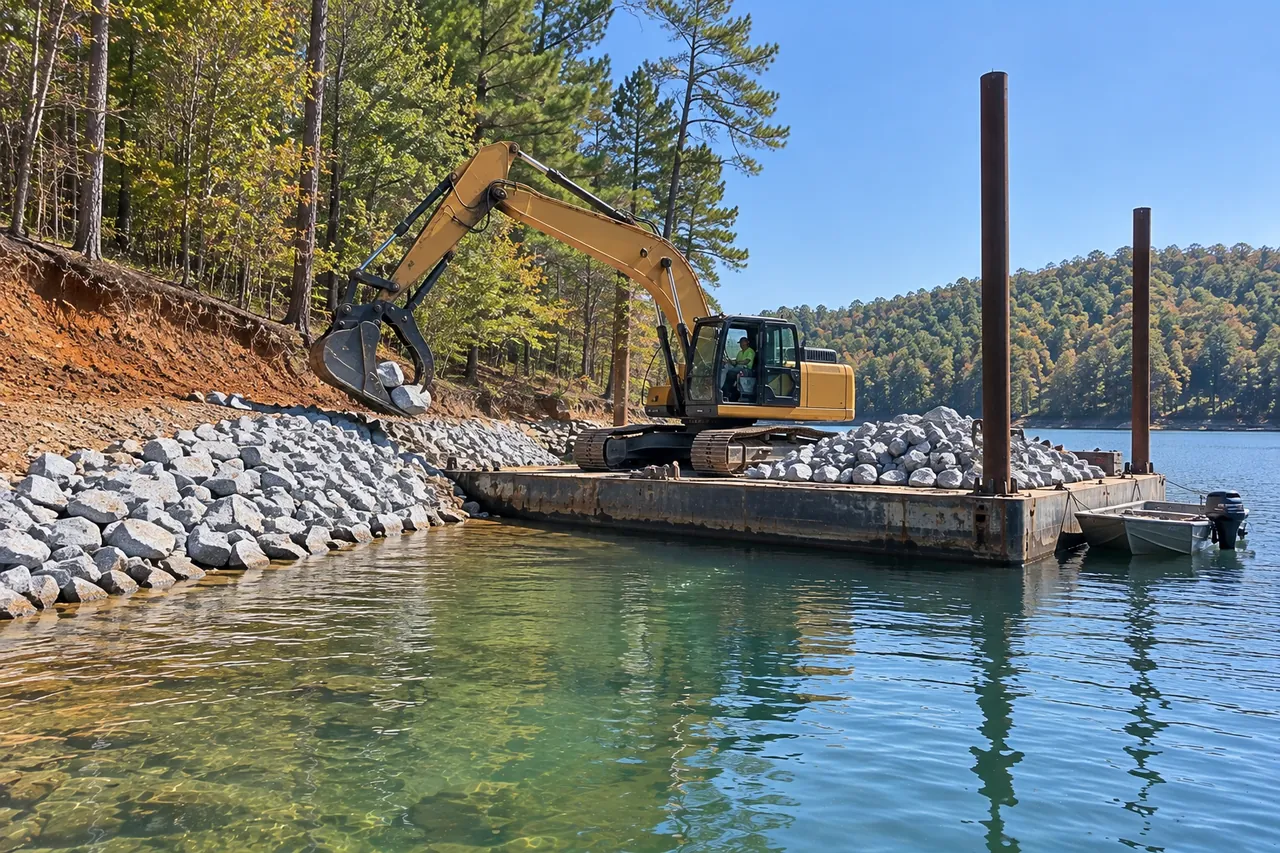
- Access. Whether the rock comes in by barge or over land, and what that means for your yard, trees and seawall or dock.
The guidelines and the PGP we read don't cover tree cutting or vegetation clearing for riprap either. If equipment access means taking out trees near the water, raise it with Alabama Power when you apply rather than on the day.
Timing and the winter drawdown
Lake Martin's drawdown begins September 1 under its FERC license, and in a normal year the lake is lowered to 484 feet, "concluding by the third week of November," according to Alabama Power. With summer pool near 491 feet, that uncovers a band of bank and lakebed about seven vertical feet tall that sits underwater at summer pool. For riprap, low water means the lower part of the bank can be seen and worked from the dry side.
We found no closed season for riprap in Alabama Power's Lake Martin guidelines or in the Corps PGPs. The PGP's general conditions say only that "Permittees are encouraged to perform work within waters of the United States during periods of low-flow or no-flow." One caution: on a lot Alabama Power identifies as a Sensitive Resource Area, "no construction or other potentially disturbing activity may take place unless and until specifically authorized by Alabama Power in writing."
Alabama Power has said permit review "can take up to 30 days or more," and once you have the permit, "The Permittee will have one year to complete construction and/or other permitted activity." If you want rock in place while the lake is down, apply in late summer, not after Thanksgiving. The winter drawdown page covers the deeper drawdown that comes every six years.
The steps, in order
- Get a site visit and a written plan. The contractor measures the length of shoreline, looks at the bank at the current water level, and puts the stone, slope, toe, fabric and access in writing.
- Gather the documents. You'll need the signed guidelines, your recorded deed, a dimensioned drawing showing where the rock goes, and HOA or architectural committee sign-off if your subdivision has one. The guidelines also ask for a sketch of every shoreline structure you have now and plan to add, your lease if you lease the lot, and a current survey if Alabama Power decides it needs one.
- Apply through Alabama Power. File online at apcshorelines.com or in its app. Filing is only a request; in Alabama Power's words it "does not constitute the issuance of a permit." The Corps verification request starts from the same place.
- Pay the fee. $400 for new riprap or added length, $200 for a substantial repair, paid before the permit is issued or before the repair work.
- Wait for the written permit. Alabama Power "does not issue any permits, or give verbal or written permission, to a permittee's contractors," so the permit comes to you.
- Build within a year, with erosion controls. Keep sediment controls working during the job, follow the ADEM conditions that come with a PGP verification, and finish inside the one-year window.
The guidelines also say the permit "does not eliminate the necessity of the Permittee obtaining any Federal, State, or local assent required by law." We didn't find a county permit for residential riprap in Tallapoosa or Elmore County, but ask your contractor what they pull locally.
What riprap costs
Nobody we could find publishes riprap prices for Lake Martin, or for Alabama generally. The closest thing is a national guide: Angi's riprap cost guide (2025 data) says homeowners "can expect to spend $70 to $400 per linear foot," that installing riprap "costs $20,000 on average," and that the normal range is $10,000 to $30,000, with most projects between 100 and 300 linear feet. Multiply that per-foot range out and a 120-foot bank comes to $8,400 to $48,000, while 240 feet comes to $16,800 to $96,000. That's arithmetic, not a forecast.
Add Alabama Power's $400 or $200 fee. Local quotes will vary with your bank's height, wave exposure, access and how much rock it takes. The cost page explains what pushes a quote up or down.
Common riprap mistakes, and the rule each one breaks
Each of these runs into a written rule. Look for them before work starts:
- Rock arrives before the written permit does. Verbal approval "is not sufficient," and unauthorized construction carries a $600 fee.
- Rock is added to an old riprap bank as "maintenance" with no call to Alabama Power.
- Fill is pushed out past the natural slope to gain yard. Backfill goes "only to the contour of the natural slope," and the PGP can't be used to regain land lost to erosion.
- Broken concrete, block or other debris gets mixed into the stone or backfill.
- A wetland edge is filled, or a rock jetty is built out from the bank.
- No silt fence or other sediment control goes up while the bank is open.
- The job drags past the permit's one-year window.
- A buyer inherits riprap whose permit terms nobody passed along. The guidelines make the permit non-transferable without Alabama Power's written consent, but a new owner is still bound by its terms.
When riprap isn't the answer
- The bank is low and only lightly eroding. "Natural bank stabilization" sits alongside riprap in Alabama Power's preference, and the PGP says vegetative and bioengineering projects "are not subject to length restrictions." See shoreline erosion.
- You already have a seawall that's failing. Rebuilding a wall has its own rules on how far out it can go, and riprap may be required at its toe. See seawalls.
- The water is pouring off the yard, not coming off the lake. Rock at the waterline won't fix runoff cutting gullies from above. Start uphill.
- You want to get back land the lake already took. The Corps PGP doesn't allow it.
Lake Martin riprap questions
Does riprap need a permit if my lot is unclassified shoreline?
Plan on yes. Unclassified means Alabama Power has no authority through its Shoreline Management Plan above full pool, but riprap sits at and below the waterline, and the permits page says lakebed work could require a permit. Ask the Lake Martin Shoreline Management office (256-825-0053) about your lot.
Is there a required rock size on Lake Martin?
Not that we found in the Martin guidelines or the Corps PGP. Ask the contractor what size and type of stone they plan and why, and get it in the quote.
Do I need filter fabric under the rock?
The PGP says fabric "shall be considered and may be required by the local authorities." Its job is to keep soil from washing out between the stones. Ask whether your plan includes it, and if not, why not.
Can my contractor get the permit for me?
A contractor can help prepare the drawing and paperwork, but Alabama Power doesn't issue permits to contractors. The permittee signs the guidelines, and the permit is in the owner's name.
How long does the permit take?
Alabama Power has said review "can take up to 30 days or more." Once issued, you have one year to finish.
Getting a riprap quote
Call (256) 667-6569 or send a request. Give us your town or road and a rough length for the stretch that's eroding. We'll pass it to one independent local contractor, who looks at the bank, writes up a plan and price, and leaves the decision to you. The referral costs you nothing.
Related pages
Sources
- Alabama Power, residential shoreline permitting guidelines for Lakes Martin, Yates and Thurlow (revised July 11, 2025)
- Alabama Power Shorelines, Permits
- U.S. Army Corps of Engineers, Mobile District, Programmatic General Permits for Alabama Power reservoirs (effective January 10, 2022)
- Alabama Power shares information on Lake Martin permits (September 13, 2023)
- Alabama Power's permitting process is a benefit to creatures great and small (September 15, 2022)
- Lake Martin Fall Extension Not Implemented (October 3, 2025)
- Lake drawdown schedule for Fall 2024 released (September 19, 2024)
- Alabama Power Shorelines, Contact
- Lake Martin Voice, Riprap seawalls at Lake Martin (July 8, 2021)
- Angi, How much does riprap cost? (2025 data)
Ready to stop losing bank?
Call or send a request to reach one independent local contractor on Lake Martin. The referral is free.