
Seawalls on Lake Martin: New Walls, Repairs & Toe Riprap
Seawalls on Lake Martin are approved one lot at a time. Alabama Power's guidelines rank riprap and natural stabilization first and say seawalls "will be evaluated on a case-by-case basis," then the Corps of Engineers' permit limits how far a wall can sit into the lake. This page compares a seawall with riprap on this lake, explains toe riprap, walks through the Corps limits on new and replacement walls, and sorts out when fixing an old wall counts as a repair and when it counts as new construction.
What people mean by "seawall" on Lake Martin
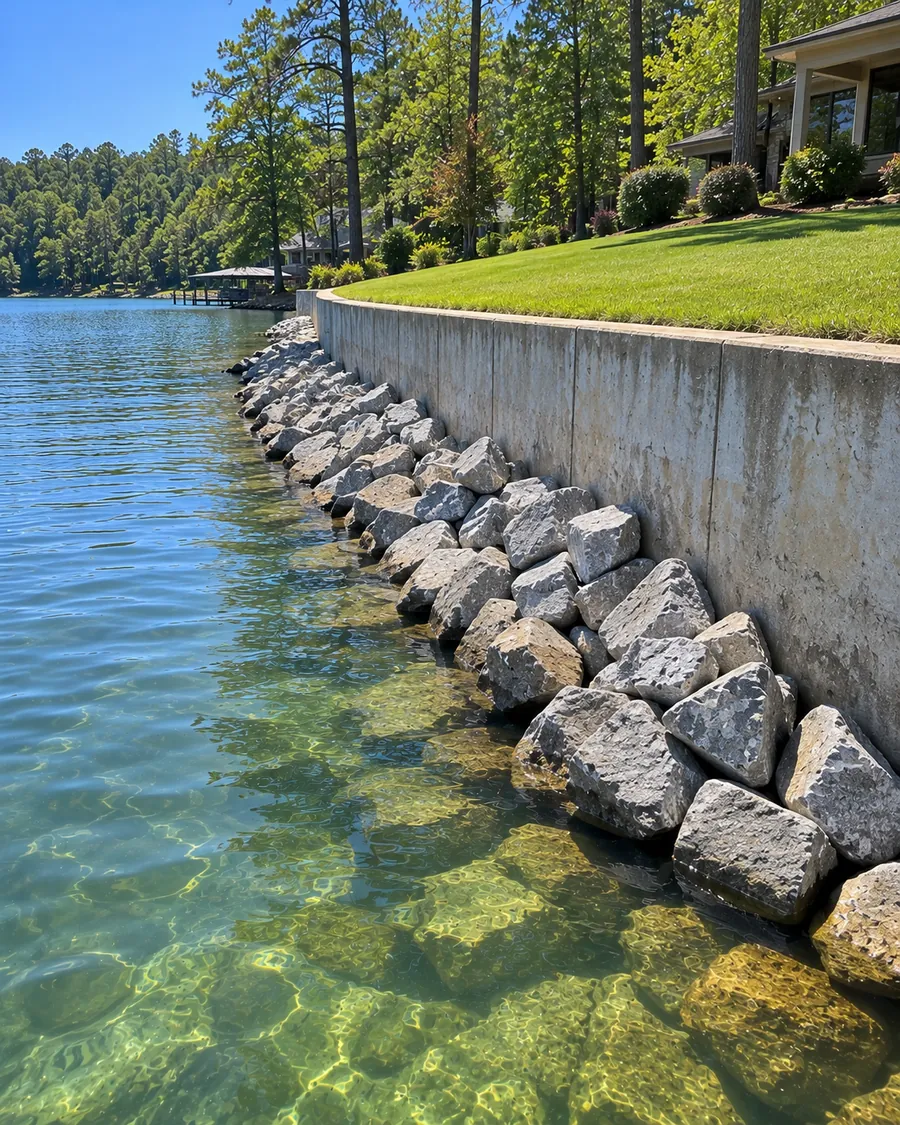
On Alabama Power lakes, "seawall" is the everyday word for almost any hard edge along the water: poured concrete, vinyl sheeting, timber and other walls, and sometimes even riprap. A 2021 Lake Martin Voice column called riprap "usually the cheapest and quickest seawall to build at the lake." The Corps of Engineers uses "bulkhead" for the same vertical structures. In this guide, a seawall means a vertical or near-vertical wall that holds the bank back, and riprap means sloped loose rock.
The distinction matters because Alabama Power's guidelines treat them differently. Here is the full bank stabilization paragraph from its Martin, Yates and Thurlow guidelines (revised July 11, 2025):
"BANK STABILIZATION: Rip-rap and natural bank stabilization are the preferred methods of erosion control; however, potential use of seawalls will be evaluated on a case-by-case basis. Approved seawalls should be constructed as close to the existing shoreline as possible for the purpose of preventing erosion of the shoreline bank. The source and kind of backfill must be approved by Alabama Power in its sole discretion. Backfill may be placed only to the contour of the natural slope of the property. No debris or foreign materials may be used as backfill. No new creosote products may be used. Rip-rap may be required at the toe of all new and reconstructed seawalls two feet above the lakebed and two feet out from the bottom of the seawall."
Seawall or riprap: how they compare here
Side by side under the Lake Martin rules
- Alabama Power's view
- Riprap is a preferred method. A seawall is evaluated case by case.
- Where it goes
- A seawall goes "as close to the existing shoreline as possible." Riprap follows the bank's slope.
- Corps limits
- Walls: 1,000 feet total, 36 inches out for new, 24 inches for replacement. Riprap: bedding fill capped below the high-water mark, no cap on rock above it.
- Rock at the base
- A wall may need toe riprap anyway, so the two often end up together.
- Permit fee
- The same for both: $400 for new work or added length, $200 for a substantial repair.
Owners usually want a wall for a flat, usable edge at the water, or because the yard runs right to a steep drop with no room for a sloped stone face. Riprap needs horizontal room to slope, and it gives a rougher edge to step on. Those trade-offs are real, but on Lake Martin the deciding question comes first: will Alabama Power approve a wall at your lot? Ask early, before paying for a design.
Toe riprap: rock at the base of the wall
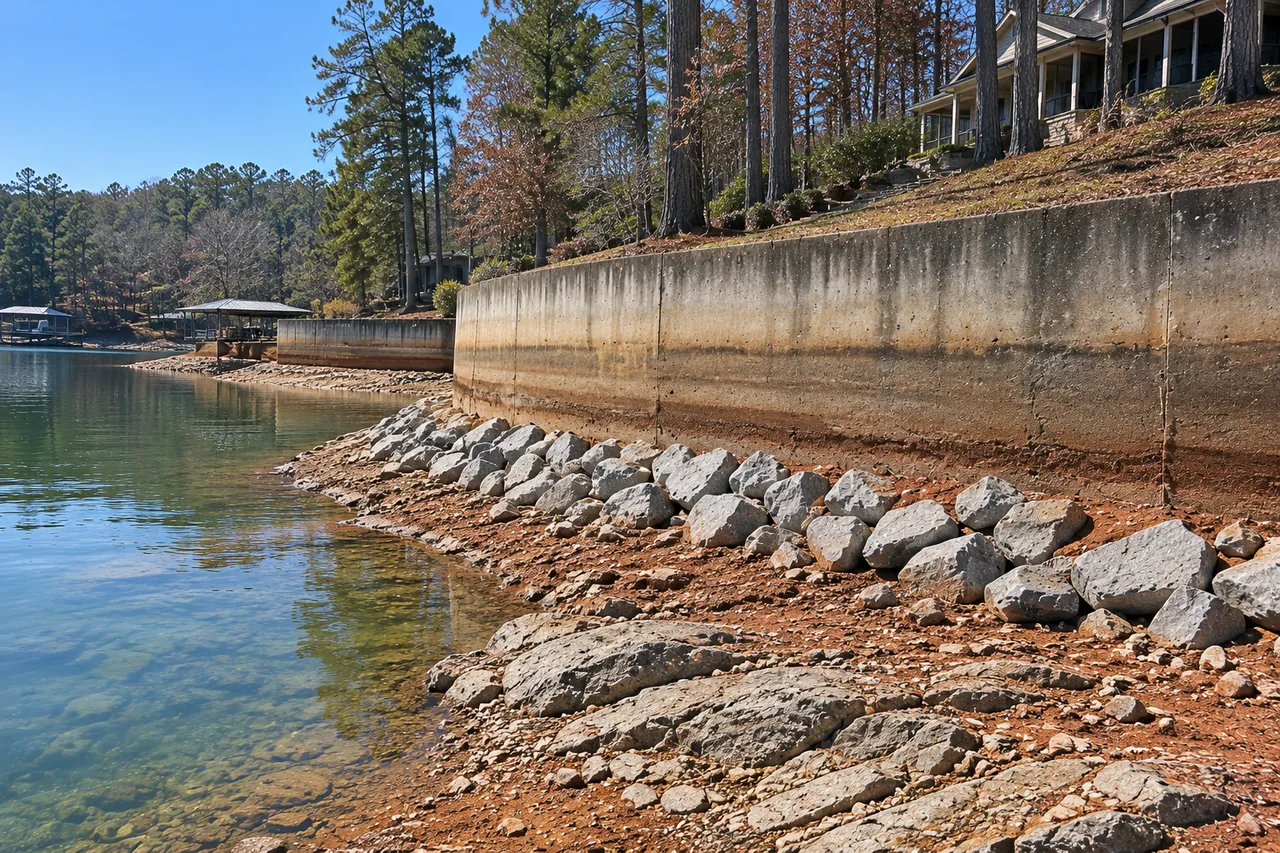
The base of a vertical wall is where waves rebound and dig. Both rule sets address it. Alabama Power's guidelines say "Rip-rap may be required at the toe of all new and reconstructed seawalls two feet above the lakebed and two feet out from the bottom of the seawall." The Corps PGP says "Riprap will be placed at the base of all bulkheads, where possible."
Read those carefully. Alabama Power's wording is "may be required," not "is required," and the Corps' is "where possible." The rule text leaves room, so ask Alabama Power whether your permit will call for it, and budget for it either way. When it is called for, the guideline's dimensions are a useful check on a quote: rock reaching two feet up the face of the wall from the lakebed and two feet out from its bottom.
The Corps limits on bulkheads
Seawalls on Alabama Power reservoirs fall under the same Corps permit as riprap, APCO-PGP-05, and each project needs a verification before work starts, requested through Alabama Power's shorelines website. The bulkhead conditions are specific:
- Length and line. "Bulkheading is limited to a total project length of 1,000 linear feet and must follow the natural contour of the existing shoreline."
- New walls. "New bulkheads shall not extend more than 36 inches waterward from the full pool elevation of the reservoir."
- Replacement walls. "Replacement bulkheads shall not extend more than 24 inches waterward from a failed bulkhead."
- Backfill. It "may not exceed an average of one (1) cubic yard per linear foot below the ordinary high-water mark."
- No reclaiming. The permit "may not be used to regain land lost to erosion, or otherwise accreted land."
- Nothing sticking out. "Groins, jetties, or solid structures perpendicular to the shore or bank are not authorized under this permit."
- Wetlands. "No wetlands may be filled."
Put together with Alabama Power's "as close to the existing shoreline as possible" and backfill "only to the contour of the natural slope," the message is consistent: a wall protects the bank where it stands. It isn't a way to push the yard out into the lake. These PGP terms are currently set to expire January 9, 2027; when you apply, ask Alabama Power whether they still hold.
Repair or new construction?
This is the question most Lake Martin seawall owners actually face, because so much of the shoreline already has a wall. Alabama Power's fee schedule sorts the work like this:
- New construction, $400. The General Construction Fee covers a new "seawall (or adding linear footage to an existing seawall)." Lengthening a wall to cover more of your shoreline is new construction.
- Substantial repair, $200. The General Repair Fee applies to "any and all residential shoreline structure repair activity of a substantial degree." Where the line falls between routine and substantial is Alabama Power's call. It can require a fresh permit before the work, and it wants a phone call before any repair that might qualify.
- Replacing a failed wall. Alabama Power's toe-riprap language covers "new and reconstructed seawalls," and the Corps treats a replacement bulkhead as its own case with the 24-inch limit. Expect a rebuild to go through the permit process, not around it.
- Destroyed by a storm or other natural cause. If a permitted structure is totally destroyed by natural causes, you can apply to replace it without paying the fees above, "so long as application is made within one hundred eighty (180) days of the structure's destruction."
- Cosmetic work. Painting a wall or pressure washing it is the only work Alabama Power's permits page leaves out of what could require a permit.
Starting a repair without approval has its own price: the Unauthorized Structure Repair Fee is $400, and the Non-Compliance Fee is $800. When in doubt, the Lake Martin Shoreline Management office is at 256-825-0053.
Signs an old seawall needs attention
The winter drawdown, when the lake sits near 484 feet instead of about 491, is the easiest time to see the lower part of a wall and the lakebed in front of it. Things worth a closer look:
- Soil or sand washing out through joints, weep holes or gaps at the base.
- Sinkholes or low spots in the yard right behind the wall.
- The wall leaning toward the lake, or sections out of line with each other.
- A gap opening under the bottom edge, where the lakebed has scoured away.
- Cracked or spalling concrete, split timber, or rusted tie-backs and caps.
Any of these is a reason to have a contractor look, and to ask whether the fix is a repair, a reconstruction, or a switch to riprap in front of or in place of the wall.
Questions to ask before a seawall job
- Will Alabama Power treat this as a repair, a reconstruction or new construction, and have you asked them?
- Where exactly will the new face sit relative to full pool or to the old wall, in inches?
- What backfill will go behind it, where does it come from, and has Alabama Power approved it?
- Is toe riprap in the plan, and at what size?
- What is the wall made of? No new creosote products are allowed.
- How will soil be kept out of the lake while the old wall is open?
- Can the work be finished within the permit's one-year window?
Seawall questions
Are new seawalls allowed on Lake Martin?
They can be. Alabama Power evaluates them case by case, and the Corps PGP allows new bulkheads up to 36 inches waterward of full pool and 1,000 feet in total length. Riprap and natural stabilization remain the preferred methods.
Can I build the new wall in front of the old one?
The Corps limit for a replacement bulkhead is 24 inches waterward of the failed one, and Alabama Power wants walls as close to the existing shoreline as possible. Whether your plan fits is a question for Alabama Power before work starts.
Is toe riprap required?
It "may be required" for new and reconstructed seawalls under Alabama Power's guidelines, and the Corps PGP calls for riprap at the base of bulkheads "where possible." Plan on it unless Alabama Power tells you otherwise.
Should I replace a failing wall with riprap instead?
It's worth asking. Riprap is Alabama Power's preferred method and has no Corps length cap above the high-water mark, but it needs room to slope. A contractor can tell you whether your bank has that room. See the riprap guide.
Getting a seawall looked at
Call (256) 667-6569 or send a request: how long the wall is, what you're seeing, and roughly where your lot is. We'll pass it to one independent local contractor, who can look at the wall and the lakebed in front of it and price the options. The referral costs you nothing.
Sources
- Alabama Power, residential shoreline permitting guidelines for Lakes Martin, Yates and Thurlow (revised July 11, 2025)
- U.S. Army Corps of Engineers, Mobile District, Programmatic General Permits for Alabama Power reservoirs (APCO-PGP-05)
- Alabama Power Shorelines, Permits
- Alabama Power Shorelines, Contact
- Lake Martin Fall Extension Not Implemented (October 3, 2025)
- Lake Martin Voice, Riprap seawalls at Lake Martin (July 8, 2021)
Is your seawall tipping or leaking soil?
Call or send a request to reach one independent local contractor on Lake Martin. The referral is free.